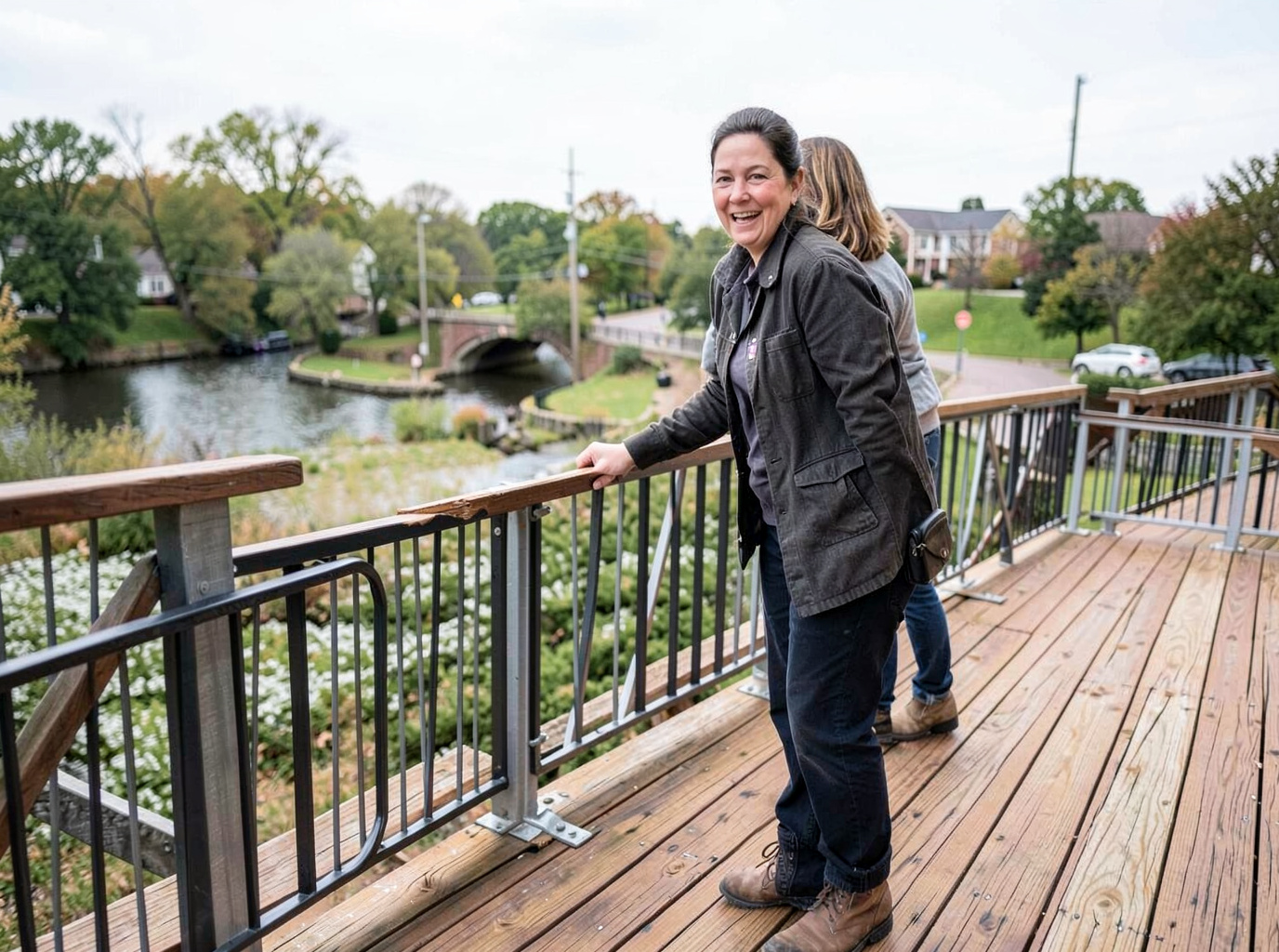
Fairfax's humid subtropical climate brings heavy summer moisture that accelerates wood rot in railings while winter freeze-thaw cycles loosen fasteners and crack posts set in clay-heavy soils common around Fairfax Circle. Older homes near the Fairfax County Courthouse and in the Fairfax Historic District often sit on sloped lots that require custom post footings deeper than standard to handle runoff and shifting ground. Cable or aluminum systems hold up better here than pressure-treated pine because they resist the constant humidity that warps wood within three seasons.
Building codes in Fairfax City emphasize 36-inch minimum heights and 4-inch sphere rules on all residential decks, with stricter historic review required inside the Old Town Fairfax boundaries near Old Town Hall. Homeowners in Annandale and Vienna frequently request railing replacements after discovering original 2x4 balusters no longer meet current load requirements once snow accumulates. Proper attachment to ledger boards matters most on homes built before 1990, where rim joists have often dried and shrunk.
Terrain around George Mason University neighborhoods features more rolling grades than flat lots in Downtown Fairfax, so railings must be stepped or angled rather than straight runs. We always check for underground utilities before digging posts and account for the red clay that holds water and pushes posts out of plumb within two winters if not backfilled with gravel.
Technician insight
In Fairfax, the thing that catches most people out with Deck Railings is the red clay soil around Fairfax Circle and Old Town that holds water and heaves posts during winter thaws. Homeowners often skip the extra gravel backfill, then wonder why new railings lean after one freeze cycle.
Railing Replacement on Sloped Lot Near Fairfax Circle
A 1990s deck in Fairfax Circle showed loose posts and rotted bottom rails after several winters. We found clay soil had pushed the original footings out of plumb. New posts were set deeper with gravel drainage and cable railings were added to keep the view open while meeting current spacing rules.
Deck Railings Services We Offer
✓Wood Deck Railing Installation
Pressure-treated or cedar railings cut and assembled on site to match existing deck framing in four-season Fairfax weather.
✓Vinyl Railing Replacement
Full swap of weathered wood railings for low-maintenance vinyl systems that resist Fairfax humidity and winter ice.
✓Cable Railing Systems
Horizontal stainless cable railings installed for unobstructed views on sloped lots common in Fairfax Station and Annandale.
✓Aluminum Railing Repair
Section-by-section fixes to dented or loose aluminum railings after heavy snow loads or shifting posts.
✓Historic District Railing Work
Code-compliant railings built to satisfy Fairfax Historic District review while meeting modern safety standards.
Deck Railings Cost in Fairfax, VA
| Service | Typical Range | What Affects It |
|---|---|---|
| Wood Railing Sections | $35–$65 per linear foot | Higher for cedar or custom baluster patterns |
| Vinyl Railing Replacement | $45–$80 per linear foot | Includes removal of old wood |
| Cable Railing System | $60–$95 per linear foot | Posts and tensioners add cost on sloped sites |
| Aluminum Section Repair | $400–$900 per section | Varies with damage extent and post reset needs |
Ranges are typical for Fairfax, VA and confirmed with an exact written quote before any work starts.
How it works
- 1
Site Assessment
Measure the deck, note soil conditions and slope, and confirm any historic district rules in Old Town Fairfax or near the courthouse.
- 2
Material Selection
Review wood, vinyl, cable or aluminum options that handle Fairfax humidity and freeze-thaw movement.
- 3
Post And Footing Work
Install or reinforce posts with gravel backfill suited to local clay soils and stepped layouts on rolling lots.
- 4
Railing Assembly And Inspection
Build sections, secure to ledger, then verify 36-inch height and spacing before final walkthrough.
Pricing
Prices depend on material choice, deck length, and any slope or historic requirements.